Postsocialism as Method: Anti-Geographies of Collective Desires
edited by Suza Husse, Fehras Publishing Practices, D’EST, Nhà Sàn Collective, Ulrike Gerhardt, Krёlex zentre published by EECLECTIC as part of D’EST Cycle #2. Artistic forms of memory at the intersection of postsocialist, queer-feminist, and decolonial narratives and imaginaries.
“The queerness of postsocialisms, in our sense, is that they are propelled by political desires that do not aim to reproduce capitalist reality […]. We may not even yet know what these radical political desires move toward. This is part of their queerness.” Neda Atanasoski and Kalindi Vora, 2020
Postsocialism as a Method: Anti-Geographies of Collective Desires is the title of the second cycle of collectively created research and program of the nomadic platform and online archive for video art, experimental, and documentary film D’EST. The platform maps artistic forms of memory at the intersection of postsocialist, queer-feminist, and decolonial narratives and imaginaries.
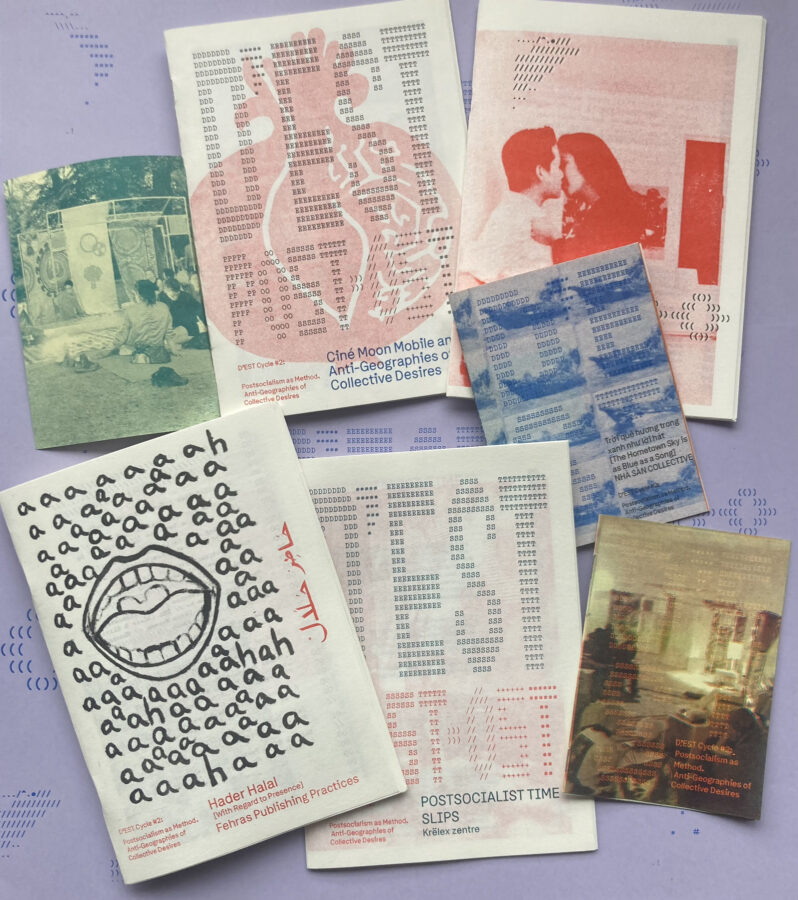
This bundle of five zines documents and expands the constellation of curated video art chapters, a nomadic cinema format, and experimental, performative publishing practices that were created by the collectives Krёlex zentre, Nhà Sàn Collective, and Fehras Publishing Practices together with D’EST’s directors Ulrike Gerhardt and Suza Husse since 2023. Following slippy timelines and diasporic geographies, they connect political desires and collective life worlds from different post/socialisms in Central Asia, Vietnam, the Eastern Mediterranean, North Africa and Southwest Asia, Germany, Europe and the US.
حاضر حلال Hader Halal [With Regards To Presence]
Hader Halal assembles texts around the literary journal Lotus: Afro-Asian Writings published by the Afro-Asian Writers Association from 1968 to the late 1990s, aiming to promote Afro-Asian solidarity and anti-colonial politics through literature and culture. Fehras Publishing Practices initiated collective fabulations in response to their Lotus collection, and especially to texts from and in solidarity with Palestine, to explore the necessity of “Publishing as a Solidarity Practice” and to mirror the interconnectedness of hopes, liberation struggles and resistance across different geographies.
Edited by Fehras Publishing Practices. Contributions by Aaron Ahalu, Anna Ehrenstein, DNA (Blair & Clint Opara), Farkhondeh Shahroudi, Fehras Publishing Practices, Iskandar Abdalla, Jyl Franzbecker, Moonis Ahmad, Promona Sengupta, Rebecca Pokua Korang, Shaunak Mahbubani, Shrujana N. Shridhar, and Vidisha-Fadescha, 40 pages
Postsocialist Time Slips
The Almaty-and-Vienna-based Krёlex zentre is an imaginary para-institution blending queer cosmopolitics, speculative world-building, inclusive diasporic aesthetics, and translocal cultural practices. Krёlex zentre’s video art chapter Postsocialist Time Slips explores translocal queer imaginaries from Central Asia and asks how experiences of loss, silence, terror, resistance, compassion and love can lead to temporal and political slippages.
Edited by Krёlex zentre. Contributions by Dilda Ramazan, Ulrike Gerhardt & Krёlex zentre, 16 pages
Trời quê hương trong xanh như lời hát [The Hometown Sky is as Blue as a Song]
Through assembled letters, graphic interventions, layered video stills, film and performance scripts, the zine relays a stream of songs of desire, nostalgia, sex, death, humor and chaos that flows through Nhà Sàn Collective’s D’EST chapter. Their selection of moving image works echoing queer imaginaries and sonic worlds reflects experiences during an era of socialist-oriented market economy, of monetizing and spiritualizing, of globalization and localization in Vietnam and the Vietnamese diasporas in the 1990s.
Edited by Nhà Sàn Collective. Contributions by Nguyễn Văn Song, Nguyễn Duy Anh, Síu Phạm, Nguyen Tan Hoang, Vu T. Thu Ha, Quynh Dong, 16 pages
Shut Up White Boy
This zine celebrates the 2002 cult film Shut Up White Boy directed by Vũ T. Thu Hà and collectively written, produced and performed by a group of queer Asian American women and dyke artists and punk rock musicians. The film shows a racialized dream-comes-true nightmare of revenge, desire, lust and fun. Together with images from key scenes of the 16mm B&W celluloid film, the zine unfolds a conversation between two co-makers of the film as well as artists and researchers on occasion of Nhà Sàn Collective’s chapter Trời quê hương trong xanh như lời hát [The Hometown Sky is as Blue as a Song] for D’EST.
Edited by Nhà Sàn Collective and Suza Husse. Contributions by Leslie Shih Shu Mah, Vu T. Thu Ha, Nguyen Quoc Thanh & Suza Husse, 24 pages
Postsocialism as Method: Anti-Geographies of Collective Desires. Ciné Moon Mobile
This introductory double zine accompanies D’EST cycle #2 at Schloss Biesdorf and Flutgraben e.V. (summer–winter 2023). Cover and inlay are its own small zine by Suza Husse and Ulrike Gerhardt, they introduce the ideas, collectivities, anti-geographies, artistic and curatorial practices that shape D’EST cycle #2. The main zine focuses on the Ciné Moon Mobile, a nomadic performative architecture and hosting vehicle developed by Aziza Kadyri and Kim Bode in exchange with Husse, Gerhardt and the East Berlin environments of cycle #2. Bode’s contribution shows how the Ciné Moon Mobile is situated in relation to Soviet cinema buses that traveled across the USSR, former Yugoslavia, and Africa in the 1960s. Kadyri weaves her investigation of Suzani embroidery – a Central Asian art form connected to invisibilized female labor and intergenerational knowledge transfer – into the making of this vehicle. Karolina Majewska-Güde and Gal Kirn deepen the historical and artistic-methodological resonances of the Ciné Moon Mobile with a view on decolonial and archival perspectives in feminist art history (Majewska-Güde) and on the history of revolutionary cinefication (Kirn).
Edited by Suza Husse, Ulrike Gerhardt. Contributions by Aziza Kadyri, Gal Kirn, Karolina Majewska-Güde, Kim Bode, Suza Husse, Ulrike Gerhardt, 24 pages
Copy editing: D’EST
Design: Aziza Ahmad and Suza Husse based on Elsa Westreicher’s design for wild recuperations. material from below
English, 122 pages, 60 illustrations, pdf
Autumn 2026
ISBN 978-3-69165-005-1
7,99 Euro
Bundle (Book & e-book)
5 zines, A5 and A6, staple bound
ISBN 978-3-69165-008-2
22,00 Euro
https://eeclectic.de/en/produkt/postsocialism-as-a-method/
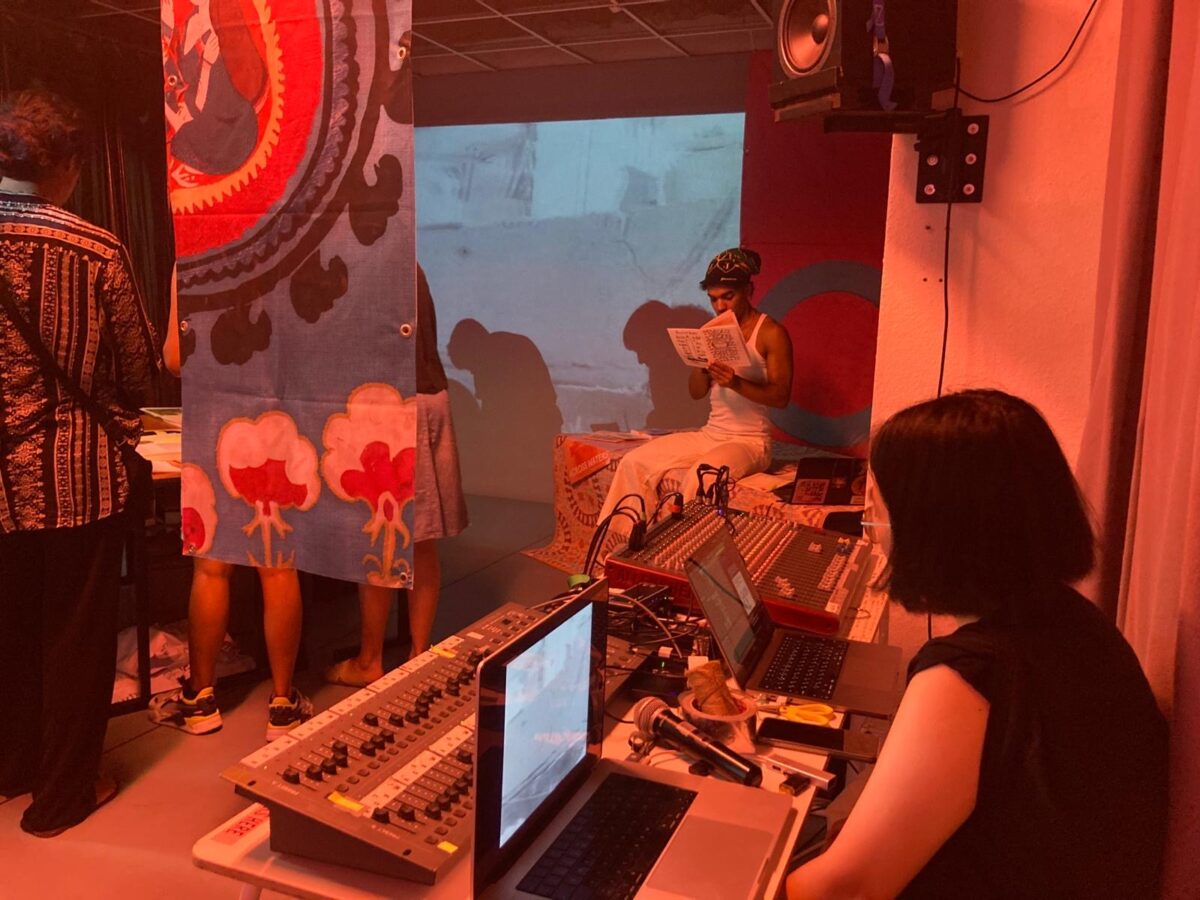
Image credit: Video-Performance by Omar Delnevo with Palestinian film archives and texts from LOTUS Afro-Asian Writings collection of Fehras Publishing Practices, Producing D’EST Zines at POSTOST Zine Club, Vierte Welt, 2024. Photo: Suza Husse